My Job Isn't Finding Things. My Job Is Being Right.
A senior analyst said six words in a demo that reshaped our entire product. This is the story of how 'my job is being right' forced us to rebuild from the ground up, and what we learned about the difference between retrieval and conviction.

TL;DR
A senior analyst's blunt feedback -- "my job isn't finding things, my job is being right" -- exposed that we had built a sophisticated retrieval engine when what analysts actually need is a system that builds conviction. This led us to redesign our entire architecture around a four-layer stack (data, orchestration, workflows, agents) optimized for analytical confidence rather than search speed.
I want to tell you about a six-second moment that changed the trajectory of our company.
It happened during a demo. A routine one, or so I thought. We were presenting KnowYourCompany.ai to a research team at a mid-size buy-side firm, the kind of firm that manages 100's of crores in AUM, runs a lean team of analysts, and is always looking for an edge.
The demo was going well by every metric I knew how to track. The head of research was engaged.
We were fifteen minutes in, and I was feeling good.
Then one of the senior analysts, someone with about twenty years of experience covering industrials, leaned back in his chair and said something I haven't stopped thinking about since.
"This is great for finding things. But my job isn't finding things. My job is being right."
What He Was Actually Saying
He wasn't criticizing the product. He wasn't being dismissive. In fact, he was doing us an enormous favor, though it took me weeks to fully understand why.
What he was saying, precisely, was this:
The competitive advantage of a skilled equity analyst has never been about access to information. It's about the ability to assemble information into a thesis, a defensible, evidence-backed view on where a company is heading, and to have enough confidence in that thesis to stake their professional reputation on it.
Every day, this analyst makes calls that influence where real capital gets allocated. His recommendations affect portfolios. His conviction (or lack of it) moves money. A wrong call doesn't just appear as a red number on a spreadsheet, it erodes client trust, affects team credibility, and in the worst case, costs people their careers.
So when he evaluates a new tool, he's not asking "Can this find information faster?" He's asking "Can this make me more right, more often?"
Those are fundamentally different questions. And at the time of that demo, our product was optimized entirely for the first one.
The Retrieval Trap
Here's what's embarrassing: we had spent months building what I genuinely believed was the best AI retrieval engine for equity research.
We could parse earnings transcripts in seconds. We could cross-reference filings across companies and time periods. We could surface relevant news, flag regulatory filings, and answer natural language questions with cited sources.
And all of that was real. All of it was useful. But all of it solved the same layer of the problem that every other AI tool in our space was solving: the retrieval layer.
The industry was (and still largely is) in a race to build better search engines. More data sources. Faster responses. Better citations. And these are meaningful improvements over the manual alternative.
But here's the trap: when you make retrieval really fast and really comprehensive, you actually amplify the analyst's downstream problem. Now they have more information, arriving faster, with less time to validate each piece.
You've sped up the finding. But you've done nothing about the trusting.
In some cases, you've made the trusting harder, because you've increased the volume of signals the analyst needs to evaluate.
We had, without realizing it, built a very sophisticated noise amplifier.
The Weeks After
I won't pretend I had an immediate epiphany in that conference room. What I had was discomfort, the kind that sits in your chest when someone has told you an uncomfortable truth and you can feel yourself resisting it.
For the next few weeks, I kept replaying the conversation. I talked to my co-founders about it. I talked to other analysts. I asked them, not "What do you want our tool to do?" but "Walk me through your last decision that you felt really confident about. What made you confident?"
The answers were remarkably consistent.
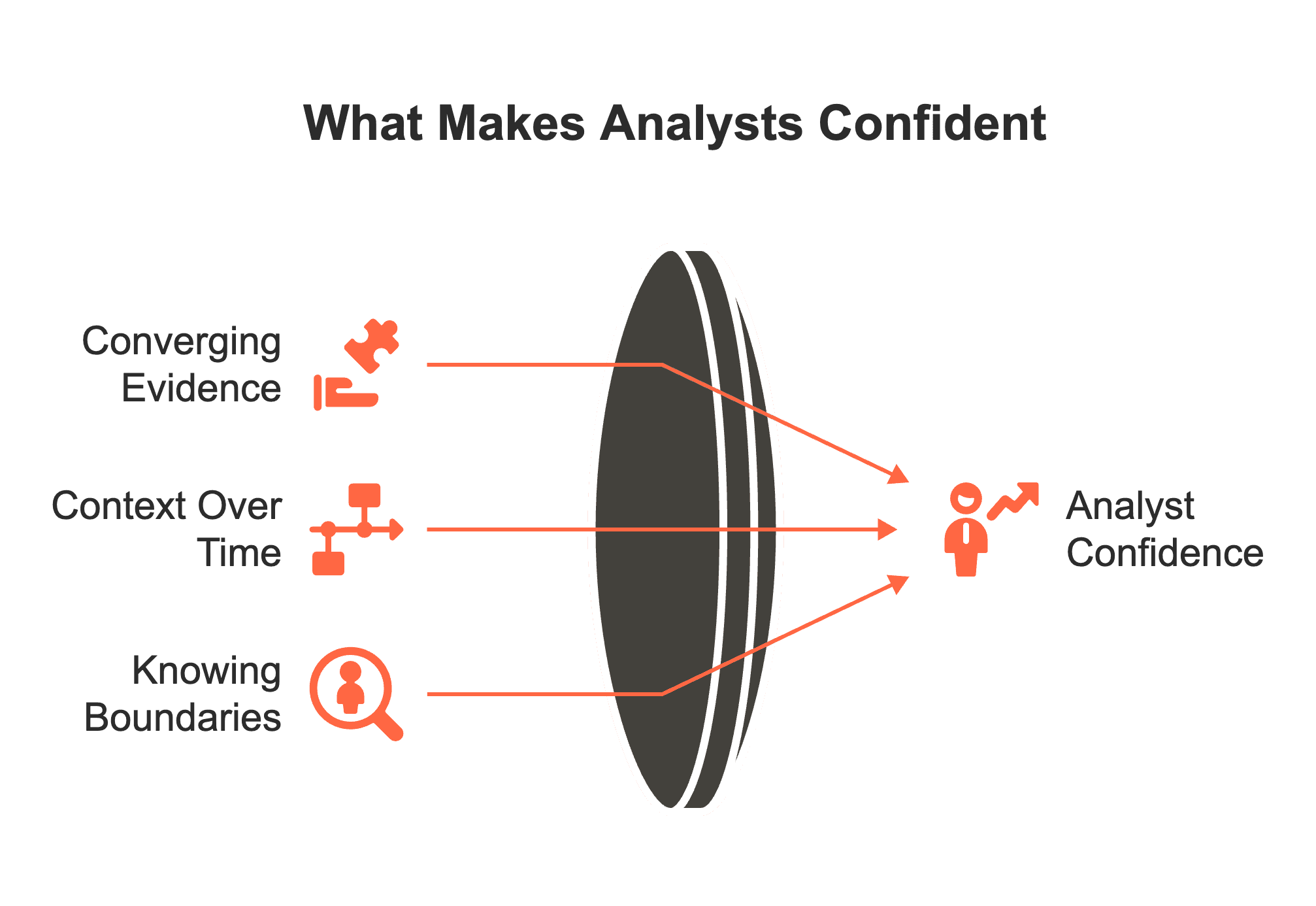
Confidence came from converging evidence. Not from finding one data point, but from seeing multiple independent data points align. The capex number matches the management commentary. The peer comparison confirms it's company-specific. The sell-side hasn't flagged it, which means it's not priced in.
Confidence came from understanding context over time. Not just what a company said this quarter, but how it compares to what they said last quarter, and the quarter before that. Patterns matter more than snapshots.
Confidence came from knowing the boundaries. Knowing what the data doesn't tell you is just as important as what it does. The best analysts I spoke with were defined as much by their discipline about what they didn't know as by their insights about what they did.
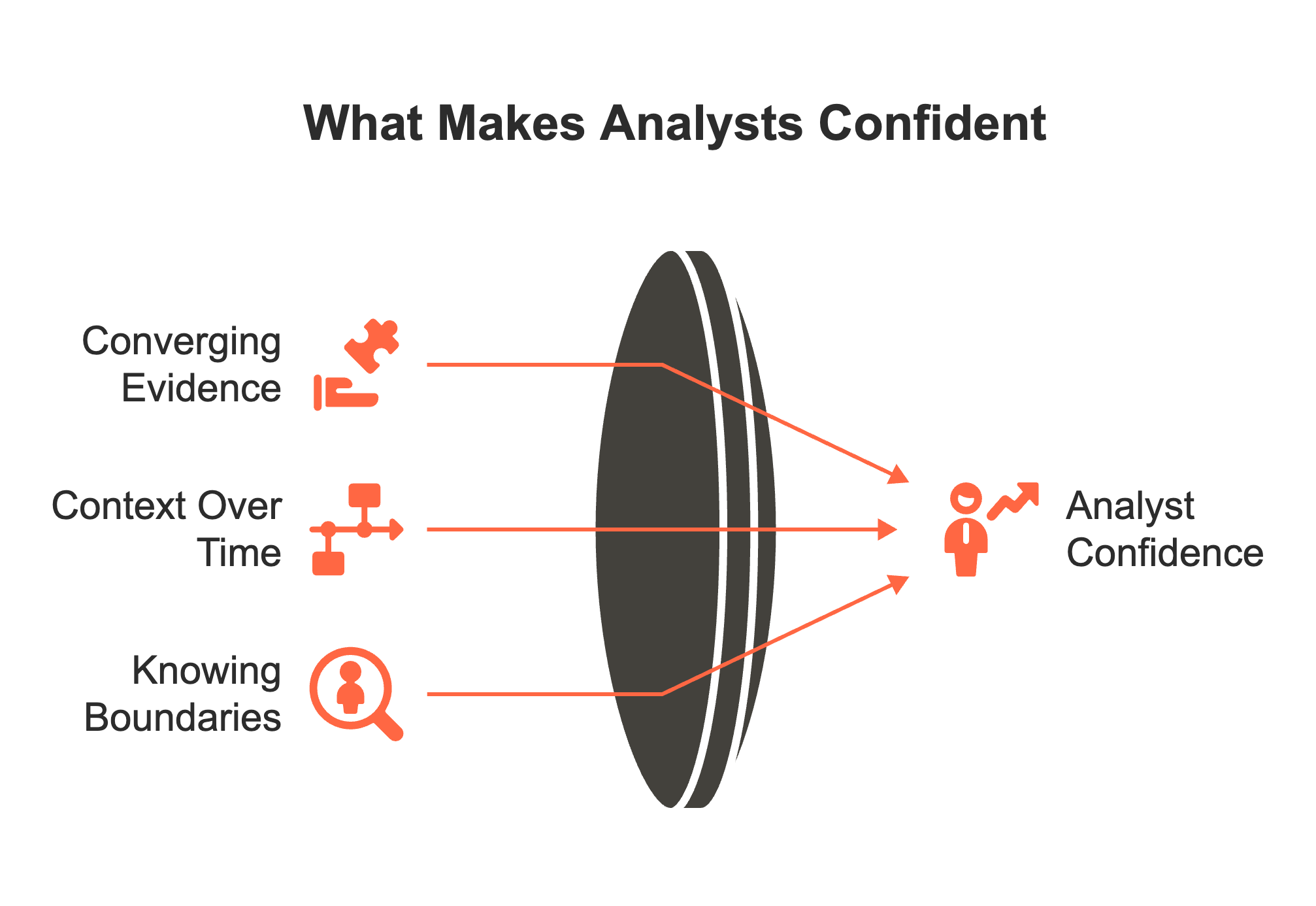
None of this was about retrieval speed. It was about analytical confidence. And our product didn't address any of it.
Going Back to the Drawing Board
I want to be clear about what "going back to the drawing board" actually meant, because the startup narrative usually glosses over this part.
We didn't throw everything away. Our data platform, the foundation of the system, was solid. We had invested heavily in data ingestion, entity resolution, and knowledge graph construction. That work wasn't wasted. It turned out to be Layer 1 of a four-layer system we hadn't yet imagined.
But we fundamentally rethought the purpose of the system.
The Product Pivot
Instead of: "How do we help analysts find answers faster?"
We started asking: "How do we help analysts be right faster?"
That one-word change, "right" instead of "find", restructured our entire product architecture.
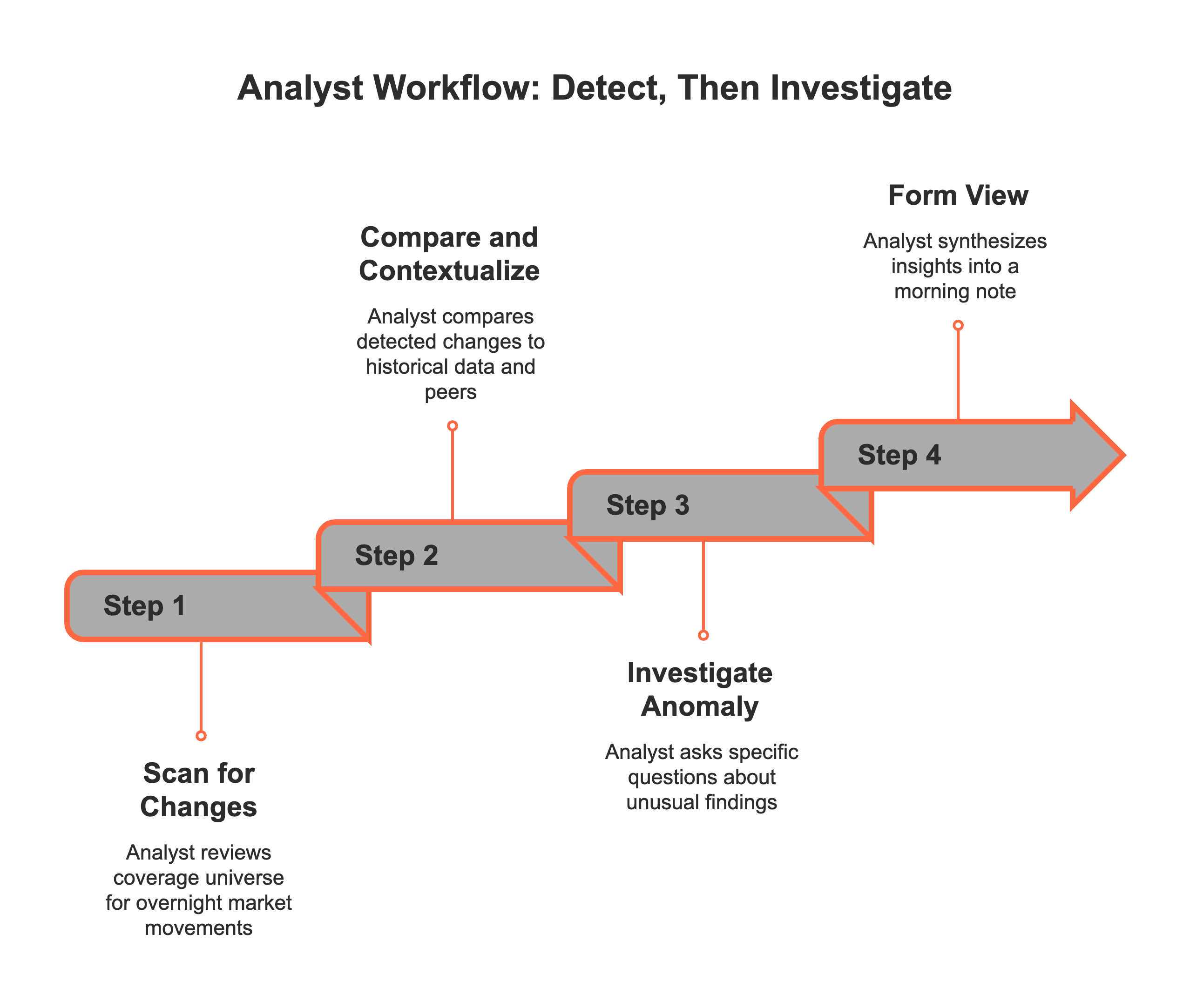
It meant building an orchestration layer. The system needed to do more than respond to queries. It needed to proactively evaluate incoming data, every filing, every transcript, every news item, and determine which changes were material. Not just "new." Material. Because in equity research, most new information is noise. The value is in identifying the small fraction that actually warrants attention.
It meant building workflows that compound. Instead of treating every interaction as a standalone query, the system needed to maintain a living analytical context for every company in the analyst's coverage universe. Each new data point should build on everything the system already knows. Analysis should get better over time, not reset with every session.
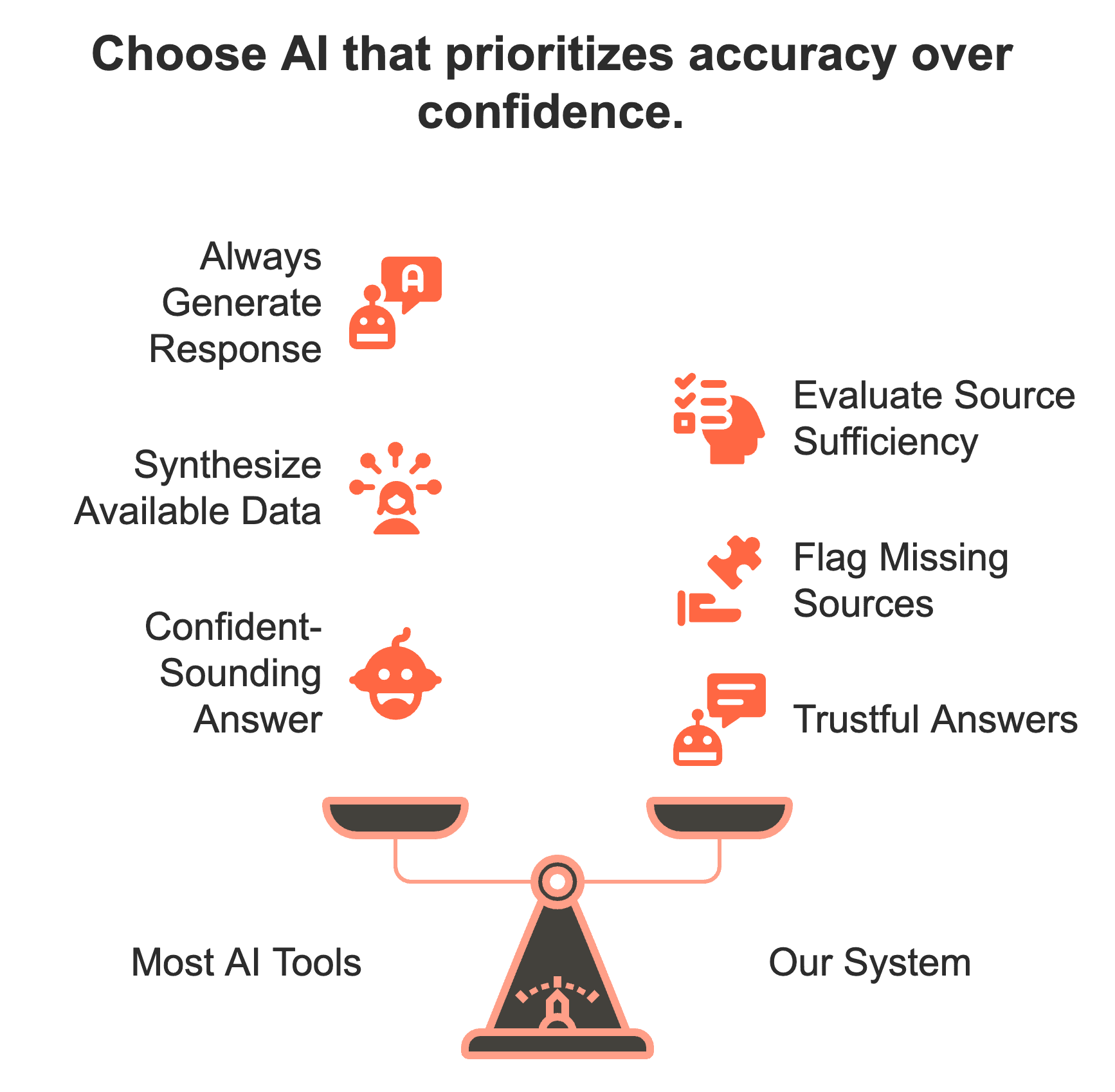
It meant constraining our agents. This was the hardest architectural decision. In a world where every AI company wants their chatbot to answer every question confidently, we chose to build agents that are constrained by the layers below them. If the data platform doesn't have enough context to support a reliable answer, the agent says "I don't have enough evidence." If the orchestration layer hasn't validated a signal, the agent doesn't pass it through.
This last point cost us some early deals. Prospective customers would test our system alongside competitors, and the competitors would always have an answer. We sometimes didn't. But the analysts who stuck with us, the ones who understood what was happening under the hood, told us something that made the trade-off worth it:
"I'd rather have a system that's right 95% of the time and honest about the other 5%, than one that's confident 100% of the time and wrong when it counts."
The Framework That Emerged
The four-layer research stack that we've built came directly from this product rethink.
-
Layer 1: Data Platform. Establish truth. Clean ingestion, entity resolution, knowledge graphs, and guardrails that ensure every claim is traceable to source data.
-
Layer 2: Orchestration. Determine what matters now. Evaluate incoming signals for materiality, conflict, and context sufficiency before they reach the analyst.
-
Layer 3: Workflows. Compound analysis. Structured, repeatable analytical processes that get more precise as new data arrives. Morning briefings, company deep dives, KPI tracking, all running continuously, not on demand.
-
Layer 4: Agents. Synthesize and communicate. But constrained by Layers 1–3. No direct access to raw data. No bypassing workflows. No unsupported reasoning.
This architecture is our answer to the analyst's challenge. It's designed not just to help you find things, but to help you build conviction in what you find.
The Lesson I Keep Relearning
I've been thinking about why that particular piece of feedback hit so hard, and I think it's because it exposed a blind spot that's common in technology startups, especially in AI.
We build for the problem we can see, not the problem our customers actually have.
We could see the retrieval problem. It's obvious: searching through hundreds of filings is slow and tedious. The solution is equally obvious: AI-powered search. The technology is impressive. The demos are compelling. And the improvement over the status quo is measurable.
But the conviction problem is invisible if you're not an analyst. It doesn't show up in feature requests (nobody says "build me an orchestration layer"). It doesn't appear in competitive benchmarks (you can't A/B test "confidence in a thesis"). It only reveals itself when you sit with someone and watch them work, or when you're lucky enough to have a customer who's generous enough to tell you the truth.
"My job isn't finding things. My job is being right."
That sentence is now on the wall in our office. Not as decoration, as discipline. A reminder that the most valuable product feedback often comes disguised as the simplest statement.
And the most important skill for a founder building in a domain like equity research isn't technical. It's the ability to listen hard enough to hear the problem behind the problem.
Other posts in the Deep Dives series:
- The Modern Equity Research Stack, the four-layer framework
- The 45-Minute Trust Gap, why speed-to-information isn't speed-to-conviction
- Most "AI for Equity Research" Tools Are Just ChatGPT With a Financial Data Plug-In, why the architecture breaks down
- Users Start with Changes, Not Questions, what 40+ analyst sessions taught us
Enjoyed this article?
Get more insights like this delivered to your inbox weekly.