The 45-Minute Trust Gap
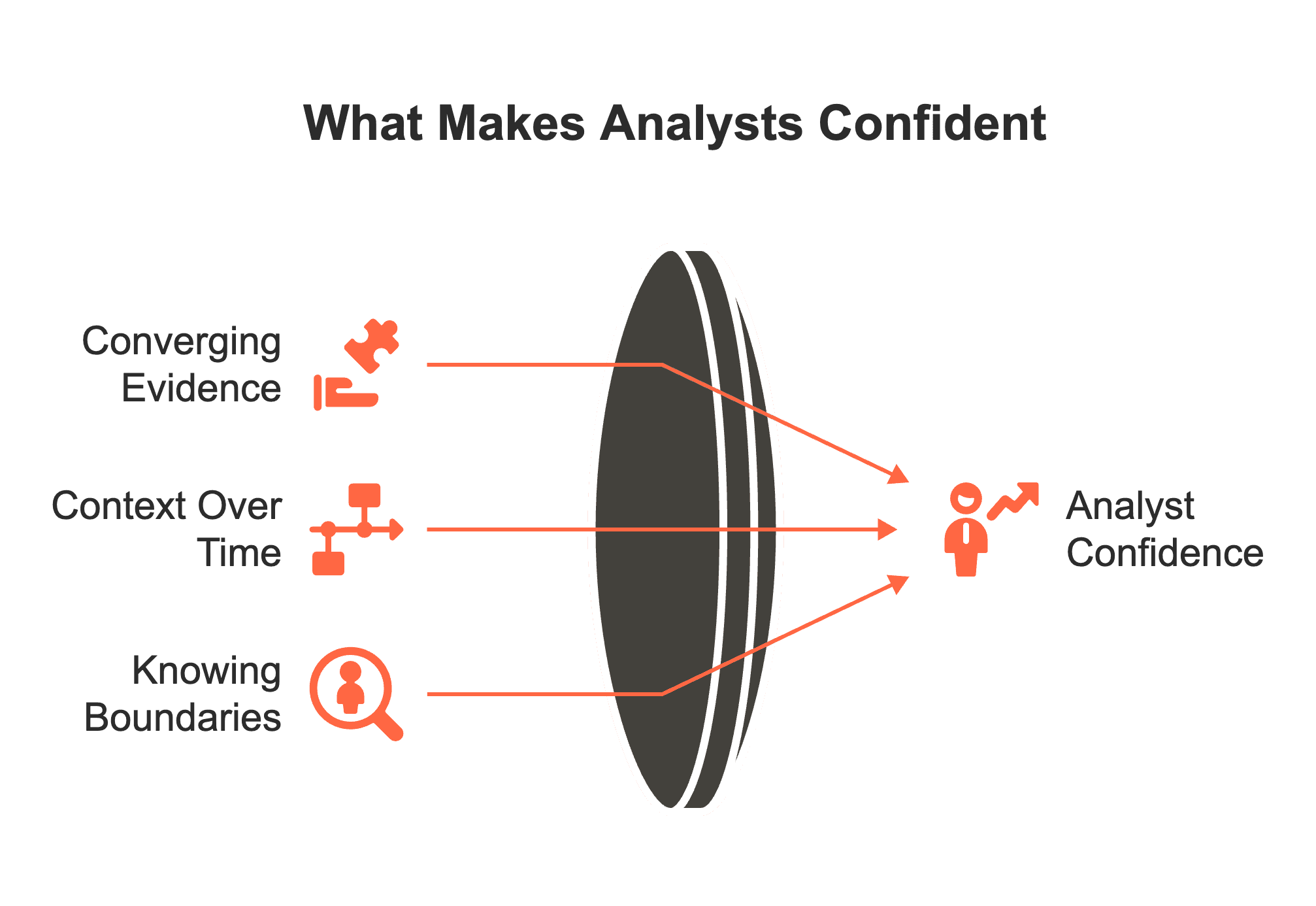
Every analyst I've observed pays a hidden cognitive overhead tax: 45 to 90 minutes of validation work between finding a signal and trusting it enough to act. This is the trust gap and most AI tools don't touch it.

TL;DR
The real bottleneck in equity research is not finding information -- it is the 45 to 90 minutes analysts spend validating each signal before they trust it enough to act. Closing this "trust gap" requires an orchestration layer that pre-computes materiality assessments, peer comparisons, and conflict detection, compressing the path from signal to conviction from 39 minutes to 6.
The scene plays out the same way in every research team I've observed.
An analyst finds something interesting. A signal in an earnings call. A deviation in a filing. A subtle shift in management tone that doesn't match the headline numbers.
And then before they can do anything useful with it the clock starts.
They cross-reference. They validate. They contextualize. They second-guess. They rebuild confidence from the ground up, because the system they're working in gave them a signal but no scaffolding to trust it.
This process which I've started calling the "trust gap" typically takes 45 to 90 minutes per signal. For a senior analyst covering 15-20 companies, that's not an edge case. It's the dominant pattern of their working day.
Over the past quarter, I've had the opportunity to sit in on more than 30 analyst workflows across buy-side firms, sell-side desks, and independent research shops. Different firms, different sectors, different tools but the same bottleneck everywhere.
And it's not where most people think it is.
The Bottleneck Everyone Assumes
When people talk about making equity research more efficient, the conversation usually centers on data access. The assumption is: if analysts could find information faster, they'd be more productive.
This assumption drives the design of most AI tools in our space. They're built as retrieval engines ask a question, get an answer, move on. And to be fair, that's a real improvement over manually searching through hundreds of pages of filings.
But retrieval speed isn't the constraint anymore.
Between Bloomberg, Ace Equity, Capitaline, and a growing ecosystem of AI-powered search tools, today's analyst has more access to more data than at any point in the history of financial markets.
The problem is what happens after they find something.
What the Trust Gap Actually Looks Like
Let me walk through a real (anonymized) example from one of the workflows I observed:
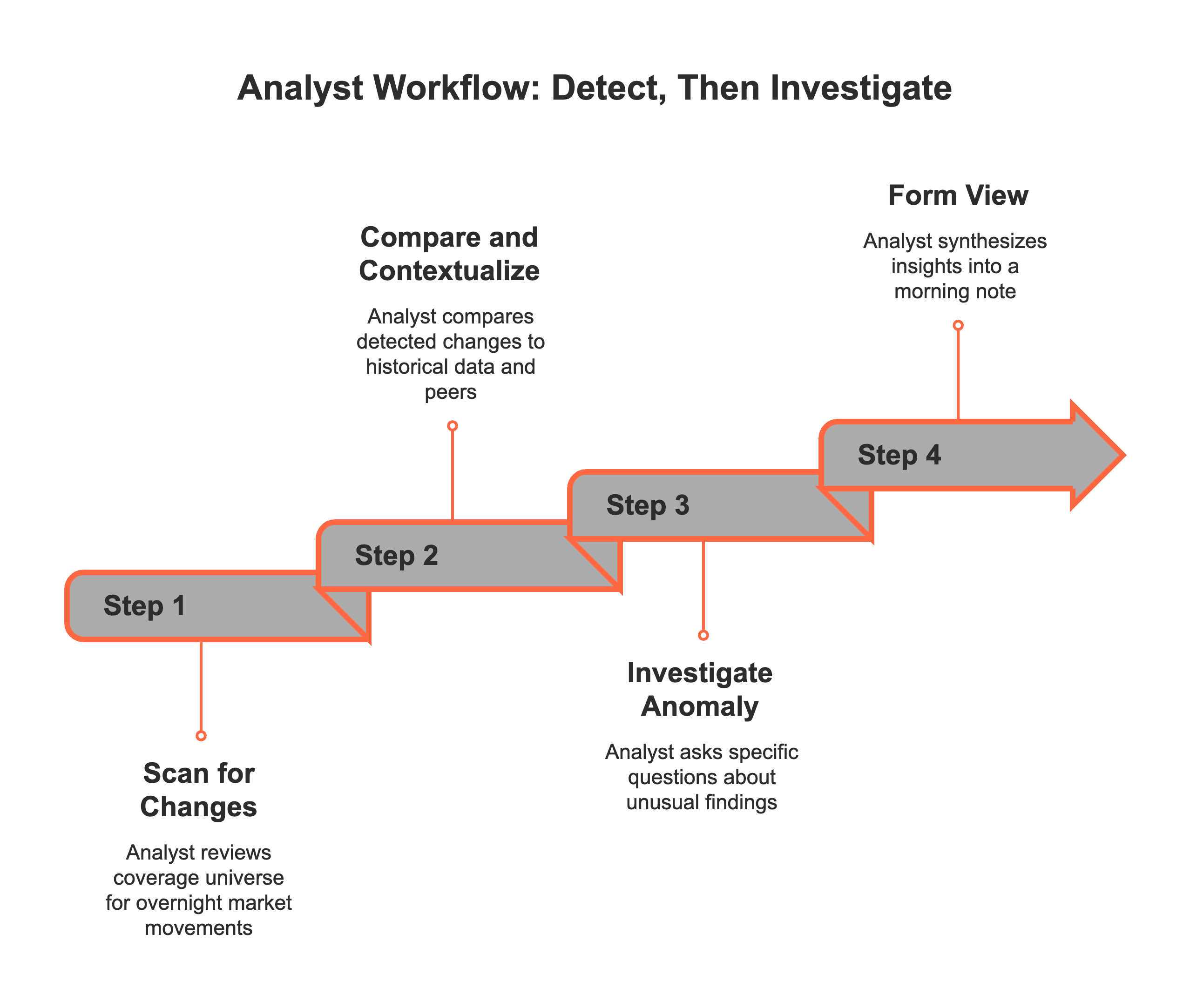
9:12 AM The analyst is reviewing overnight transcripts. She spots that a mid-cap industrial company revised its full-year capex guidance upward by 12% during the Q3 call. The headline numbers look fine. But the capex revision, buried in the Q&A section, doesn't match the tone of the prepared remarks.
9:14 AM She opens the prior quarter's transcript to compare guidance language. The previous quarter mentioned "disciplined capital allocation." This quarter says "accelerated investment to capture near-term demand." That's a meaningful shift.
9:22 AM She checks whether the capex revision was already flagged by the sell-side. Pulls up three broker notes. Two don't mention it. One notes it in passing but doesn't flag it as material.
9:31 AM She cross-references the company's capex trajectory against two direct peers. One peer also raised capex; the other cut. So this isn't a sector-wide trend it's company-specific. That makes it more interesting.
9:38 AM She checks whether the stock moved on the report. It did up 2.3% but volume was average. So the market may not have fully digested the capex signal.
9:44 AM She pulls the company's historical capex-to-revenue ratio to see if a 12% increase is unusual. It is. In the last five years, capex increases have averaged 3-5% year-over-year.
9:51 AM She's now confident enough to add this to her morning note with a short thesis: management is signaling a shift from capital discipline to growth investment, and the market hasn't priced it in.
Total time from signal to conviction: 39 minutes.
Every step in that chain was necessary. She wasn't wasting time. She was building the analytical confidence required to make a recommendation that carries real capital implications.
But here's the thing: every one of those validation steps could have been pre-computed.
The Difference Between Speed-to-Information and Speed-to-Conviction
This is the distinction that changed how I think about building for equity research.
The Core Distinction
Speed-to-information is a retrieval problem. Can you find the right document, the right number, the right quote? This is what search engines including AI-powered ones are optimized for.
Speed-to-conviction is a systems problem. Can you present a signal alongside the context needed to evaluate it? Can you pre-compute the comparisons, flag the deviations, surface the conflicts so the analyst's judgment call happens from a position of informed confidence rather than raw uncertainty?
These require fundamentally different architectures.
A retrieval tool answers: "What did the CEO say about capex?"
A conviction system answers: "Capex guidance changed by 12%. This deviates from the 5-year average of 3-5%. One of two direct peers also raised capex. Sell-side coverage has not flagged this as material. Stock moved 2.3% on average volume."
Same underlying data. Radically different starting point for the analyst.
Why Most AI Tools Miss This
The current generation of AI research tools and I say this as someone building one is largely stuck at the retrieval layer.
The dominant paradigm is: take a large language model, connect it to financial data sources, and let users ask questions. This is useful. It genuinely saves time on the "finding" phase.
But it doesn't address the trust gap.
Here's why: a chatbot-style interface treats every query as independent. It doesn't know what the analyst's coverage universe looks like. It doesn't know what "material" means in context. It doesn't track how guidance has evolved over time. It doesn't proactively flag when something has changed that warrants attention.
It answers the question you ask. It doesn't tell you which questions you should be asking.
That's the difference between a tool and a system.
What Closing the Trust Gap Requires
When I first started building KnowYourCompany.ai, I thought we were building a better way to ask questions about companies. The analyst I wrote about in my last post (the one who said "my job isn't finding things my job is being right") helped me understand that the question itself isn't the unit of value. The conviction is.
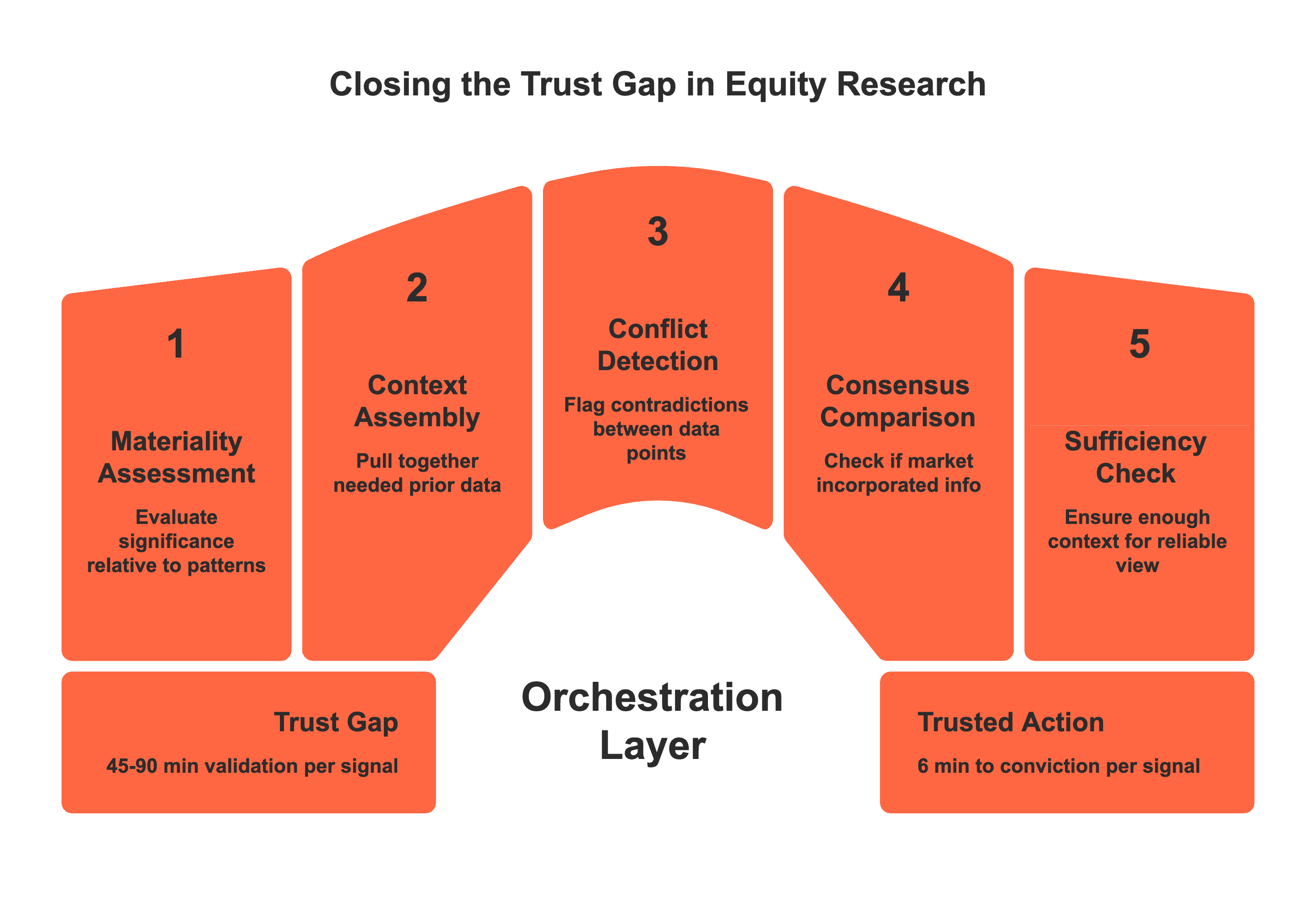
Closing the trust gap requires what I've been calling the Orchestration layer a system that sits between raw data and the analyst and performs the work of evaluation:
- Materiality assessment. Is this change significant relative to historical patterns and peer behavior? A 12% capex increase is noise for one company and a signal for another.
- Context assembly. What prior data is needed to evaluate this signal? Pull it together before the analyst asks for it.
- Conflict detection. Does this signal contradict other data points? If the company is raising capex but management commentary emphasizes cost discipline, that's a tension worth flagging.
- Consensus comparison. Has the market or sell-side already incorporated this information? If so, the signal's alpha value drops.
- Sufficiency check. Is there enough context to form a reliable view? If not, the system should say so rather than generating a confident-sounding but underpowered answer.
When these evaluations happen automatically and continuously, the analyst's workflow changes fundamentally. Instead of spending 45 minutes building conviction from scratch, they're reviewing pre-assembled evidence and making the judgment call that only a human can make.
They're still the decision-maker. But the cognitive overhead that used to consume their day is now handled by the system.
The Analyst's Day, Reimagined
Imagine the same analyst from the example above, working with a system that has an orchestration layer:
9:12 AM She opens her morning briefing. The system has already flagged the capex revision as material: 12% increase vs. 5-year average of 3-5%, classified as a significant deviation. It notes that one of two direct peers also raised capex, but the other cut suggesting company-specific rather than sector-wide dynamics.
9:13 AM She sees the system's context note: sell-side coverage has not flagged this in post-earnings reports. Stock moved 2.3% on average volume. Historical capex-to-revenue ratio chart is attached.
9:15 AM She reviews the prior quarter's guidance language side-by-side with this quarter's. The system has highlighted the shift from "disciplined capital allocation" to "accelerated investment to capture near-term demand."
9:18 AM She adds her analysis to the morning note, with higher confidence and additional color from the pre-assembled context.
Total time from signal to conviction: 6 minutes.
Same analyst. Same judgment. Same intellectual rigor. But instead of spending 39 minutes assembling evidence, the system did the assembly. She spent her time on what actually matters: thinking.
That 33-minute difference, multiplied across 10-15 signals per day, across a team of analysts that's where the compounding happens.
The Implication for How We Build
This insight that the trust gap is the real bottleneck has fundamental implications for how AI research platforms should be designed.
It means the value isn't in how fast you can answer a question. It's in how reliably you can close the gap between signal and conviction.
It means the architecture matters more than the model. A bigger LLM doesn't close the trust gap. A better orchestration system does.
And it means the right metric for an AI research tool isn't "time to answer." It's "time to trusted action."
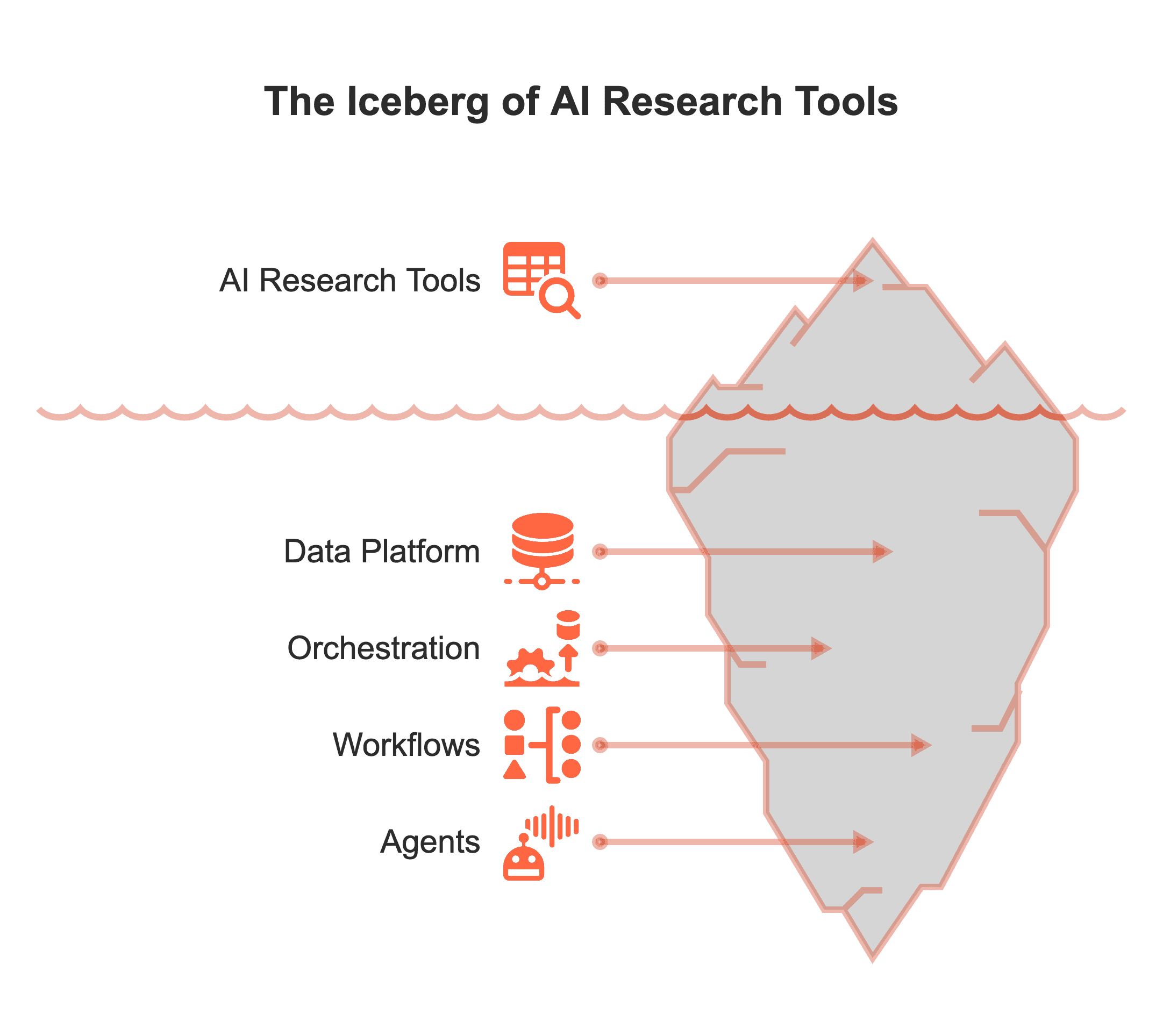
We're building KnowYourCompany.ai around this principle. The system is designed as a compounding stack data platform, orchestration, workflows, agents where each layer increases the decision confidence of the layer above it.
We're early. But the analysts using our system are already telling us the same thing: the value isn't that they find things faster. It's that they trust what they find.
And in this market, trust is alpha.
Other posts in the Deep Dives series:
- The Modern Equity Research Stack, the four-layer framework
- "My Job Isn't Finding Things. My Job Is Being Right.", how one analyst sentence reshaped our product
- Most "AI for Equity Research" Tools Are Just ChatGPT With a Financial Data Plug-In, why the architecture breaks down
- Users Start with Changes, Not Questions, what 40+ analyst sessions taught us
Enjoyed this article?
Get more insights like this delivered to your inbox weekly.