Users Start with Changes, Not Questions
We spent three months watching analysts use our system. We built one thing. They wanted something else entirely. The lesson was simple, and it changed everything about how we build: analysts don't start their day with questions. They start with changes.

TL;DR
After observing 40+ analyst sessions, we discovered that 85% of research workflows begin with change detection -- scanning for what moved overnight -- not open-ended questions. This insight led us to redesign our system around a "detect and investigate" model with continuous monitoring and materiality scoring, rather than the Q&A paradigm that dominates AI tools.
We spent three months watching analysts use our system. We built one thing. They wanted something else entirely.
Not because they were confused. Because they understood their own workflow better than we did.
The lesson was simple, and it changed everything about how we build: analysts don't start their day with questions. They start with changes.
And if that distinction sounds subtle, I promise you it's not. It's the difference between building a search engine and building a research system. Between a tool that waits for instructions and one that earns its place on a second monitor.
The Assumption We Got Wrong
When we set out to build KnowYourCompany.ai, we made the same assumption every AI research tool makes:
Analysts need a better way to ask questions about companies.
It's a reasonable starting point. The entire AI industry is oriented around Q&A. You type a prompt. The system responds. The interaction model is question-and-answer, inherited from search engines, refined by chatbots, and now being applied to every domain from customer support to equity research.
So we built accordingly. We invested in natural language query processing. We built sophisticated retrieval pipelines that could parse earnings transcripts, exchange filings, news articles, and alternative data sources. We designed citation systems so every answer traced back to a source.
And all of that was technically impressive. Our query engine was fast. Our answers were well-structured. In side-by-side tests against other tools, we often produced better, more nuanced responses.
But then we started watching what analysts actually did with the system. And we discovered something that made us rethink the entire interaction model.
What Morning Looks Like for a Real Analyst
Let me describe a pattern we observed across dozens of user sessions.
6:45 AM. A senior analyst covering specialty chemicals logs into our system. She has 14 companies in her coverage universe, plus another 20 she monitors peripherally. Overnight, three of her coverage companies had developments: an exchange filing, a competitor earnings release, and a management presentation at an industry conference.
She doesn't type a question.
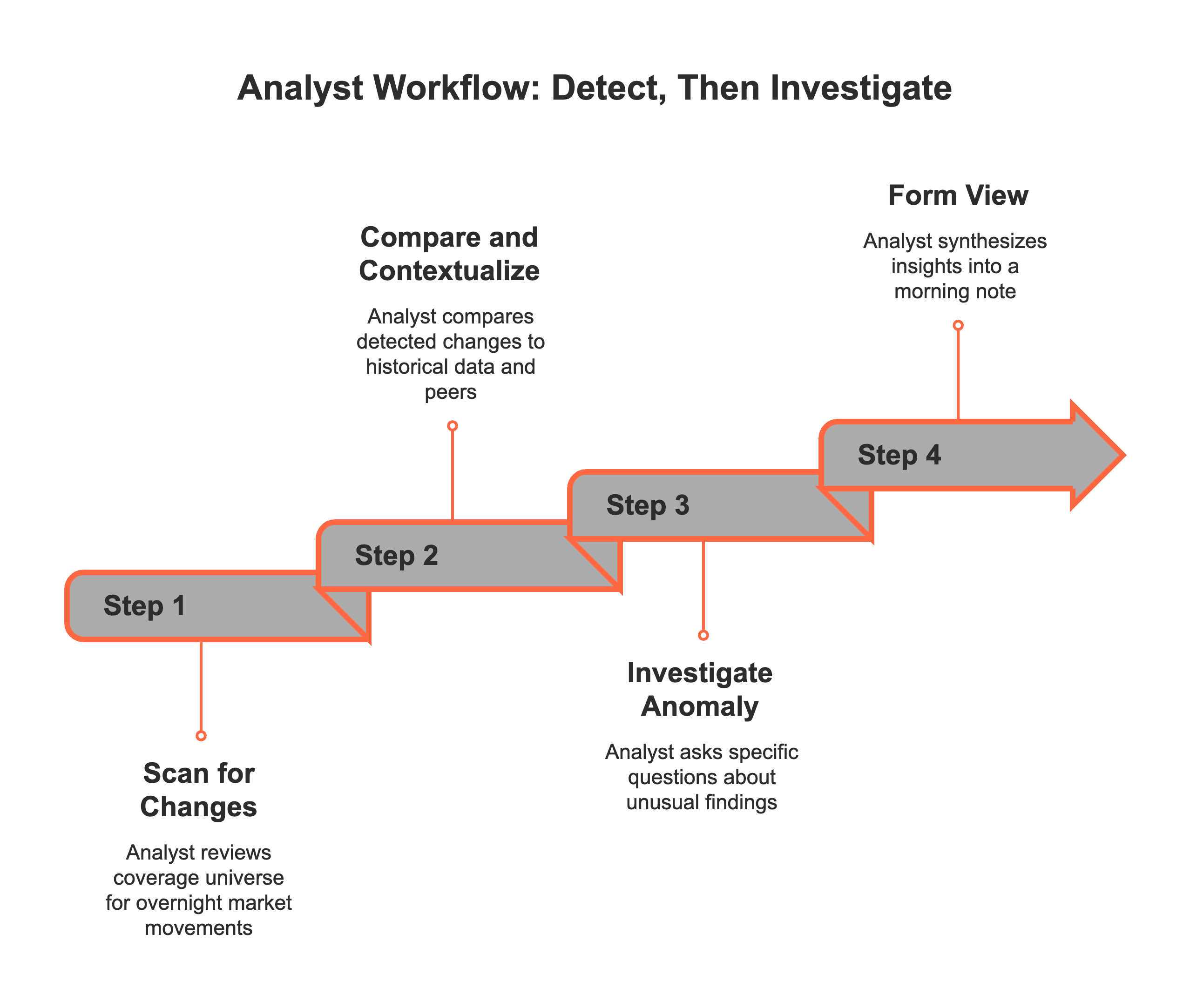
She opens her coverage dashboard and scans for what changed.
6:47 AM. The exchange filing catches her eye. It's a material contract amendment. She clicks through, not to ask about it, but to see how the contract terms compare to the prior agreement. She's looking for the delta, not the document.
6:52 AM. She moves to the competitor earnings release. She doesn't read it start to finish. She pulls up the prior quarter's results side-by-side and scans for where the numbers diverged from the trajectory. Operating margins ticked up 40 basis points. That's interesting; it might signal an industry-wide input cost tailwind that affects her primary coverage name.
6:58 AM. She checks the conference presentation. She's not looking for new information per se. She's looking for whether management's tone shifted from the last public appearance. The word "disciplined" appears twice where "growth" appeared four times last quarter. That's a signal.
7:04 AM. Now she types her first question: "What's the historical correlation between [competitor]'s margin expansion and [coverage company]'s input cost trends?"
That question didn't come from nowhere. It emerged from 19 minutes of change detection: scanning, comparing, and identifying the anomaly worth investigating.
When we timed this workflow across 40+ user sessions, 34 of them followed the same basic pattern. The first interaction with the system wasn't a question. It was a scan for changes.
The Taxonomy of Starting Points
As we accumulated more observation data, a clearer picture emerged. Analysts interact with research systems from one of three starting points:
Starting Point 1: "What changed?" This is the dominant mode. The analyst is scanning their coverage universe for new developments, comparing current data to prior periods, and looking for deviations from expected patterns. It's anomaly detection, and it accounts for roughly 60% of the first interactions we observed.
Starting Point 2: "How does this compare?" The analyst has already identified something interesting and wants comparative context. How does this company's margin trajectory compare to peers? How does current guidance language compare to last quarter? This is contextualization, roughly 25% of first interactions.
Starting Point 3: "What do I think about this?" The analyst has a forming thesis and wants to pressure-test it against available evidence. This is the closest to traditional Q&A, but even here, the question is more nuanced than simple retrieval. It's asking the system to help evaluate a view, not generate one. Roughly 15% of first interactions.
The critical insight: only 15% of analyst workflows begin with the kind of open-ended question that Q&A systems are optimized for.
The other 85% begin with some form of change detection or comparison.
And we had built our entire product around the 15%.
Why the Best Analysts Have Always Worked This Way
This pattern isn't new. It didn't emerge because AI tools exist. The best analysts have always operated on a detect and investigate model.
I had a conversation about this with a portfolio manager who's been in the business for over two decades. His description of how he generates alpha was almost mechanical:
"I'm not looking for answers. I'm looking for things that moved that shouldn't have moved, or things that didn't move that should have. The analysis starts after I find the anomaly."
He described his mental model as a set of continuously running "monitors": expectations about how his coverage companies should be performing based on industry dynamics, historical patterns, and management commitments. When reality deviates from those expectations, a flag goes up.
The investigation that follows the flag is where the actual intellectual work happens. But the investigation is triggered by change detection, not by curiosity.
This maps almost exactly to what we observed in our user sessions. The analysts who generated the most original insights, the ones whose morning notes contained ideas their colleagues didn't have, were consistently the ones who spent the most time in "scanning mode" before switching to "investigation mode."
They weren't asking better questions. They were detecting more meaningful changes.
The Chatbot Paradigm Gets This Backwards
Here's why this matters for how AI research tools should be designed:
The dominant interaction model in AI, the chatbot, assumes the user knows what to ask. It waits passively for a prompt. When it gets one, it responds. The quality of the output depends almost entirely on the quality of the input question.
But the highest-value moments in equity research come from spotting things you didn't know to look for.
A 40-basis-point margin expansion at a peer company that signals an industry-wide input cost shift. A subtle change in management tone from "growth" to "discipline" that precedes a strategic pivot. A contract amendment that restructures the economics of a key customer relationship.
None of these insights start as questions. They start as observations, pattern-breaks that catch a trained eye.
A chatbot misses all of this. Not because the underlying model is bad, but because the interaction model is wrong. A Q&A system only activates when prompted. A research system should activate when something changes.
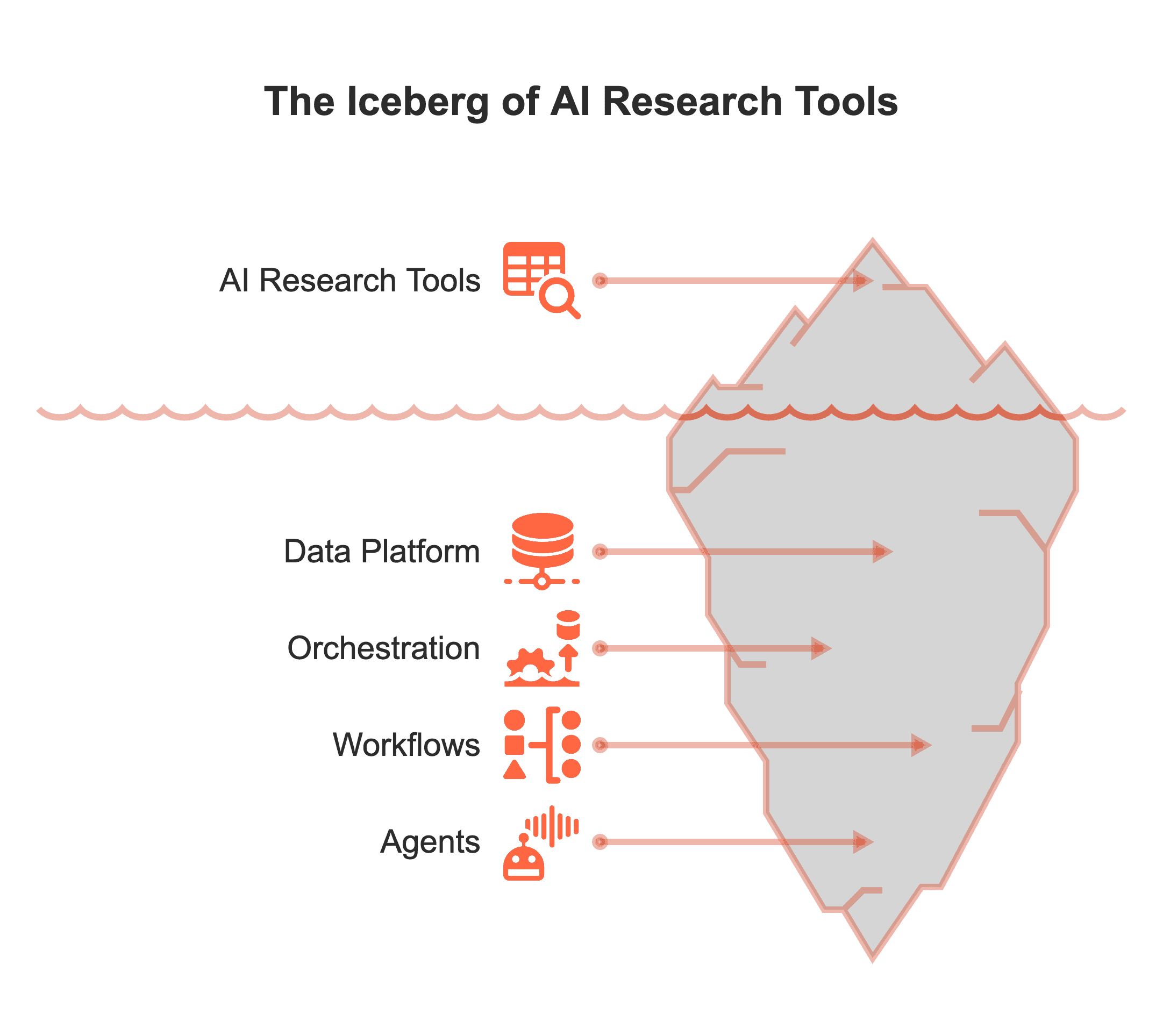
This is the fundamental distinction between what I've been calling a "retrieval layer" and an "orchestration layer." Retrieval responds to queries. Orchestration monitors reality.
What "Detect and Investigate" Looks Like in Practice
When we redesigned our system around the detect and investigate workflow, the architecture changed significantly.
Continuous monitoring, not on-demand querying. The system doesn't wait for an analyst to ask a question. It continuously ingests data across every company in the analyst's coverage universe, filings, transcripts, news, alternative data, and compares new information against established patterns.
Materiality scoring before surfacing. Not every change is worth flagging. If a company's revenue comes in at ₹1,010 crore against an expectation of ₹1,000 crore, that's technically a change, but it's noise. The orchestration layer applies materiality thresholds, calibrated to each company's historical volatility and the analyst's coverage priorities, before deciding whether a change warrants attention.
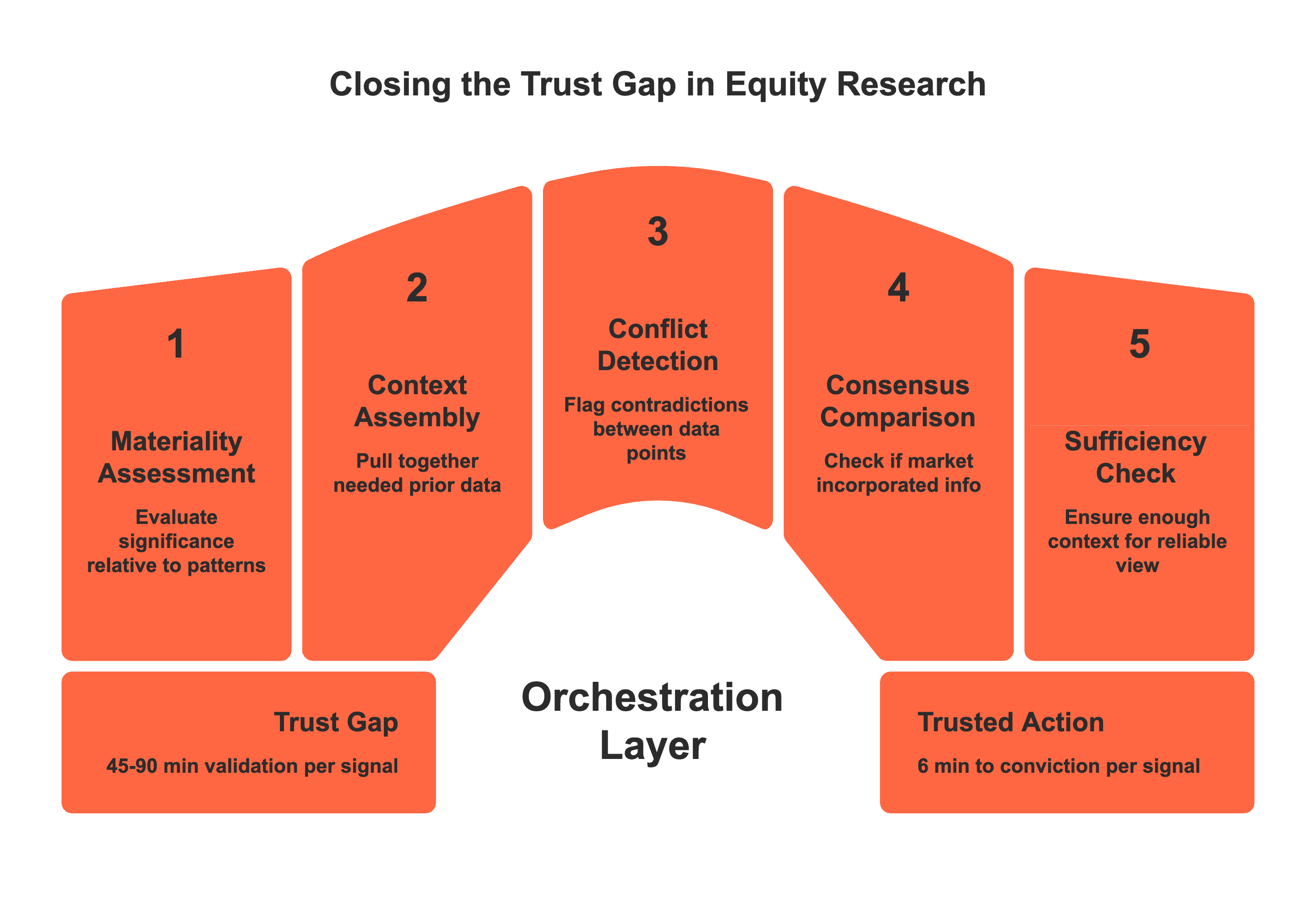
Contextual packaging of changes. When the system does flag a change, it doesn't just say "this number moved." It presents the change alongside the context needed to evaluate it: prior period comparison, peer comparison, consensus positioning, and an assessment of whether the data is sufficient to form a reliable view.
Seamless transition to investigation. Once an analyst identifies a change worth investigating, the system shifts from monitoring mode to analysis mode. The analyst can drill down, ask follow-up questions, and pressure-test hypotheses, all within the context the system has already assembled.
The Q&A capability still exists. But it's the second act, not the opening scene.
The Morning Briefing, Redesigned
Let me replay that morning workflow with the redesigned system:
6:45 AM. The analyst opens her morning briefing. Instead of a blank query box, she sees a prioritized list of changes across her coverage universe, ranked by materiality.
6:46 AM. The top item: the competitor's margin expansion. The system has already flagged it as a 2-standard-deviation move relative to the company's trailing four-quarter trend. It notes that input costs for the broader specialty chemicals sector declined 7% last quarter, suggesting this may be an industry-wide tailwind rather than company-specific improvement. It links to the relevant filings and shows the margin trajectory chart.
6:48 AM. Second item: the management presentation tone shift. The system has extracted and compared language patterns across the last four public appearances. It flags the "growth to discipline" vocabulary shift and notes that this pattern, historically across her coverage universe, has preceded capital allocation changes within two quarters.
6:50 AM. Third item: the contract amendment. The system has compared the new terms against the prior agreement and highlighted two material changes: a pricing escalation clause and a volume commitment reduction. It flags that the combined impact could affect the company's revenue run rate by an estimated 3-5%.
6:52 AM. Now she starts investigating. She pulls the thread on the margin expansion, asking the system to quantify the input cost tailwind's potential impact on her primary coverage name. She drills into the management tone shift to assess whether the language change aligns with recent capex trajectory.
7:05 AM. She's writing her morning note. It contains three original insights that emerged from the system's change detection, insights she didn't have to go looking for.
Total time to morning note: 20 minutes. No time wasted formulating questions about things she didn't yet know had changed.
The Broader Lesson
This experience taught us something about building AI products that extends well beyond equity research:
Users don't always know what to ask. And that's not a failure of the user. It's a feature of complex, information-rich domains. The most valuable insights often come from the data itself, not from human curiosity. An AI system that waits for prompts is leaving the highest-value use case on the table.
The best tools mirror how experts already think. We didn't invent the detect and investigate workflow. Analysts have been working this way for decades, scanning research terminals, reading filings, watching price feeds. What we did was give the workflow a computational backbone. The system does what the analyst's brain was already doing, but faster, more consistently, and across a larger coverage universe.
Interaction models matter as much as model quality. The AI industry is obsessed with making models smarter, faster, and more capable. And those improvements are real and valuable. But the way users interact with those models is at least as important as the models themselves. A brilliant AI behind a Q&A interface is like a Formula 1 engine in a sedan; the power is there, but the chassis can't use it.
We're still early in understanding how analysts want to work with AI. Every week brings new observations, new surprises, and new reasons to rethink assumptions.
But one thing has become clear: the future of AI in equity research isn't a better chatbot. It's a system that watches what matters, surfaces what changed, and gets out of the way while the analyst does what only they can do, think.
Other posts in the Deep Dives series:
- The Modern Equity Research Stack, the four-layer framework
- The 45-Minute Trust Gap, why speed-to-information isn't speed-to-conviction
- "My Job Isn't Finding Things. My Job Is Being Right.", how one analyst sentence reshaped our product
- Most "AI for Equity Research" Tools Are Just ChatGPT With a Financial Data Plug-In, why the architecture breaks down
Enjoyed this article?
Get more insights like this delivered to your inbox weekly.