Understanding Market Cycles: A Researcher's Perspective
How experienced researchers approach market cycles, sector rotation, and the rhythms that drive equity markets over time.
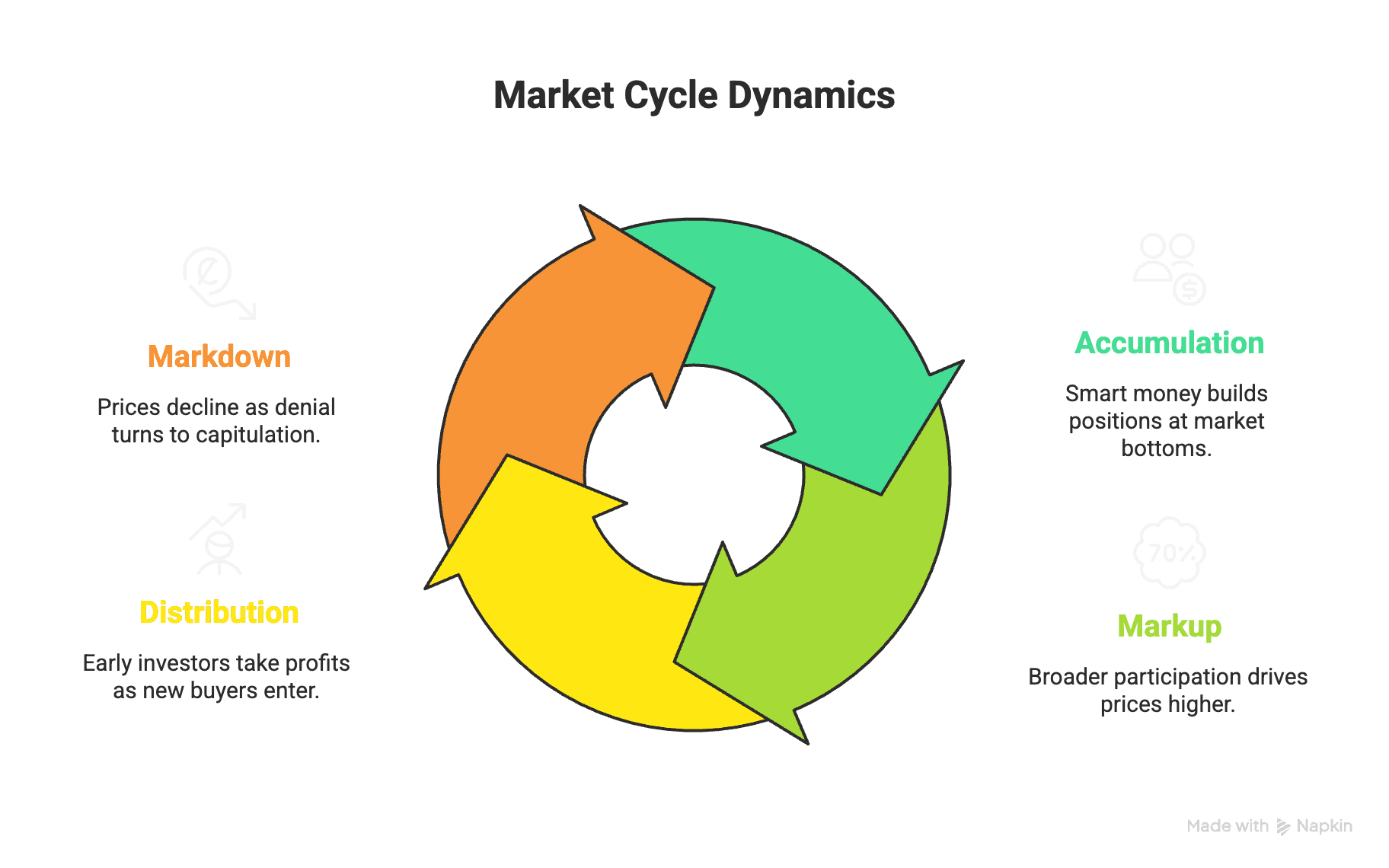

Markets move in cycles. While the specifics vary, the underlying patterns of expansion, peak, contraction, and trough repeat across time periods and asset classes. Understanding these rhythms is essential for any serious equity researcher.
The Anatomy of a Market Cycle
Market cycles typically proceed through four distinct phases:
1. Accumulation Phase
Following a market bottom, smart money begins building positions. Sentiment remains negative from the previous decline, but valuations have become attractive. Key characteristics:
- Low trading volumes
- Persistent pessimism in media coverage
- Improving fundamentals often ignored
2. Markup Phase
As the recovery becomes apparent, broader participation drives prices higher. This is typically the longest phase of the cycle.
"The best gains often come from being early to the markup phase—but being too early is indistinguishable from being wrong."
Characteristics include:
- Rising volumes and volatility
- Improving earnings revisions
- Sector rotation begins
3. Distribution Phase
Near the peak, early investors begin taking profits while new buyers continue entering. The market may make new highs, but participation narrows.
- Concentration in fewer names
- Increasing speculation in lower-quality assets
- Divergences between price and momentum indicators
4. Markdown Phase
The cycle completes with a decline. Severity varies, but the pattern is consistent: denial, then recognition, then capitulation.
Sector Rotation Through the Cycle
Different sectors tend to outperform at different phases:
| Cycle Phase | Typically Outperforming Sectors |
|---|---|
| Early Recovery | Consumer Discretionary, Financials |
| Mid Cycle | Technology, Industrials |
| Late Cycle | Energy, Materials |
| Recession | Utilities, Consumer Staples, Healthcare |
Timing is Difficult
While these patterns are historically consistent, timing cycle transitions is notoriously difficult. Most investors are better served by understanding where we are in the cycle rather than trying to predict exact turning points.
Implications for Research
Understanding market cycles should inform your research process in several ways:
Thesis Construction
Your investment thesis should account for cycle positioning. A company might have excellent fundamentals, but if it's highly cyclical and we're late in the expansion, that context matters.
Valuation Considerations
Cyclical companies require careful valuation analysis. Peak earnings in an upcycle may not be sustainable; trough earnings in a downcycle may understate normal profitability.
Risk Management
Position sizing and portfolio construction should reflect cycle awareness. Late-cycle portfolios typically benefit from increased quality exposure and reduced beta.
Looking Forward
No one rings a bell at the top or bottom of a cycle. The goal isn't perfect timing—it's maintaining awareness of the current environment and adjusting research focus accordingly.
The researchers who consistently outperform are those who combine rigorous company-level analysis with a nuanced understanding of the broader market context. Both skills matter; neither alone is sufficient.
Enjoyed this article?
Get more insights like this delivered to your inbox weekly.


